
Demystifying Trotskyism
A quick primer on Stalin's fiercest critic and the ideological tradition that his writings created after his untimely death at the hands of a Soviet assassin.

To discuss this piece, or any of my other work, join the SLSC subscriber chat by clicking this link right here so we can talk it out.

A Brief History of Trotsky
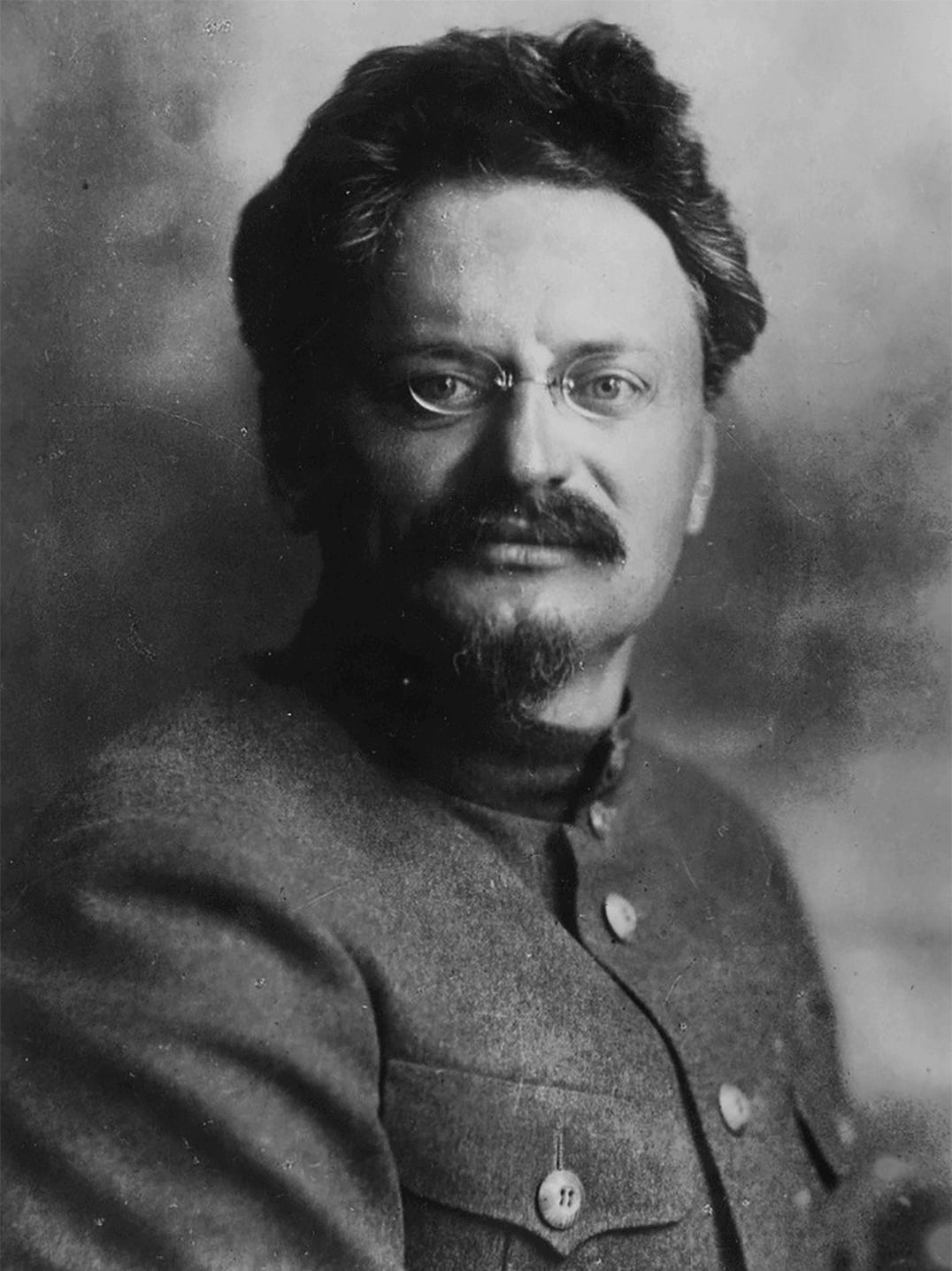
Leon Trotsky began his journey as a key figure in the 1905 Russian Revolution, helping to organize the St. Petersburg soviet (worker’s council). He formed a countervailing force that balanced Lenin’s vanguardism, seeking to inspire spontaneous revolution amongst the masses rather than rely on party infrastructure. In the end, Lenin’s vanguardism won the day, and after a brief period in exile – a recurring theme in Trotsky’s life – he returned to Russia and joined forces with the Bolsheviks. He served as the primary organizer of the Red Army and was the practical architect of the October Insurrection. Under the fledgeling USSR, Trotsky became the People’s Commissar for Foreign Affairs and later for War as well.
Ever going against the grain, with Lenin falling ill, dying in 1924, and the subsequent rise of Stalinist forces – to which Trotsky was vehemently opposed – he became marginalized within party infrastructure. He was eventually expelled from the Communist Party in 1927, exiled internally in 1928, and eventually deported from the USSR in 1929. Trotsky bounced around the world, writing communist political theory fiercely critical of Stalin and Stalinism (that would become the backbone of modern Trotskyism). He lived in Turkey, France, Norway, and was eventually caught by a Soviet assassin in Mexico city on August 21st, 1940. He was killed with an ice pick–typical of Stalin’s brutish nature.
Central Tenets of Trotskyism
Theory of Permanent Revolution
Trotsky’s keystone theoretical flourish was the concept of “Permanent Revolution,” around which his internationalism and criticism of Stalin would grow. Trotsky’s core argument was that “backward” countries (agrarian, feudal societies, or otherwise less-developed nations) would need to undergo both a democratic revolution and a workers’ revolution simultaneously, rather than letting the bourgeois gain strength and form their own liberal democracy and eventually create conditions where institutions could form and drive forward socialism separately. This sublimation of liberal capitalist democracy was carried out spontaneously in China under Mao – though through a distinct, unique means (which we’ll be covering in a week or two) – and in Cuba by Guevara and Castro.
Trotskyists themselves may not draw a direct line between “Permanent Revolution” and these movements, in both cases, the sublimation of agrarian societies into communist ones was the means by which communism was achieved. Both also served as hubs from which socialism spread regionally. To my mind, there is an ideological rhyme between these two cases and Trotsky’s thoughts on the concept of Permanent Revolution. Neither China nor Cuba were heavily industrialized, yet they formed the two most robust, lasting examples of Marxist-Leninist communism–even outlasting the USSR. Guevara’s internationalism and dedication to a socialist alternative for the Global South echoes this strategy of supporting revolutions skipping over the liberal capitalist democracy period entirely. This internationalist perspective stands in sharp contrast to Stalin’s “socialism in one country” approach to which Trotsky was diametrically opposed.
On the Nature of the USSR:
Under Stalin’s bureaucratic hierarchy, which eventually became the seat of power in the USSR with Josef Stalin as its most senior member, the Soviet Union became what Trotsky would call a “degenerated worker’s state.” Rather than socialism, he claimed that under Stalin’s brutal and corrupt leadership the Soviet Union had become a degenerated lesser form of social organization where the means of production are owned collectively, however the benefits accrue to only party insiders and not the workers themselves. He called this degenerated bureaucracy a parasitic institution, sucking the life and labor from the workers while enjoying the fruits of the workers’ labor all by themselves. It’s hard to argue that Stalin was fair, egalitarian, or even concerned with the lot of the common worker in the abstract, much less their actual lives and livelihoods.
Trotsky saw but one way out of the degenerated workers’ state that Stalin had wrought: A political revolution to restore control and agency to the workers’ councils and the workers themselves, rather than allow for the fat-cattery of the Stalinist bureaucracy. This is not to say, he wanted to institute a bourgeois capitalist democracy. Quite the contrary, Trotsky wanted the communism of the USSR to be the communism of Marx, and thought that it should concern itself with the needs of the working class–not simply create new means of ruling over the working class, as Stalin had.
Democratic Centralism:
Within the Communist party, democratic measures were to be given the utmost importance, with thorough debate and deliberation upon each issue being necessary. Once the party made its decision, though, Trotsky favored unified action. It was through discipline and unity, he wrote, that the working class should rule over themselves, and that this structure and form would suffice for executing the will of the people as expressed by the Communist Party. This organizational form is called democratic centralism, and is a key feature of Trotskyist thought.
Critique of Bureaucracy:
Unlike Lenin and Stalin, however, Trotsky was exceedingly wary of lending too much power and deference to any officials, lest they become corrupted and abuse their position. The expansive power structure that Stalin built was largely busy with the maintenance of the bureaucracy, and not with workers’ affairs. Concentrating power outside the working class by creating a new upper caste served Stalin’s interests, but did tangible harm to the people of the Soviet Union, and Trotsky was very insistent on the dangers and maladaptive nature of such a monstrosity.
Trotskyism Post-Trotsky
Fragmentation and Reorganization:
After Trotsky’s assassination in Mexico City, the movement fractured into a few different camps. The Fourth International was reorganized in 1946 but suffered splits over the nature of the USSR, the role of national liberation movements, and the interpretation of the 1956 Hungarian Revolution, to which one of Stalin’s more iron-fisted military and political responses to internal struggles for democratic representation was levied. Imre Nagy and the student-led attempt to establish an independent, communist Hungary from under the heel of Stalin’s degenerated state was crushed summarily, and Stalin’s priorities became abundantly clear–self-preservation over self-determination.
Key Tendencies:
The International Socialist Tendency (IST):
This faction of Trotskyists, led by the Socialist Workers Party (UK/US), broke with the Fourth International. They argue that the USSR was “state capitalist” rather than a degenerated workers’ state, and emphasized “entryism” into mass labor parties and trade unions as a vehicle for achieving socialist gains..
The Reunified Fourth International (FI-92):
This more traditionalist strain of Trotskyism maintains the original “degenerated workers’ state” analysis and focuses on building revolutionary parties within existing mass organizations.
Committee for a Workers’ International (CWI):
Similar to the IST, CWI is known for its focus on “entryism” into social democratic political parties and its analysis of the USSR as a form of state capitalism, pointing to the state-run and state-benefitting economy that exploited workers for the benefit of the privileged caste of bureaucrats.
Modern Trots:
Contemporary Trotskyist groups are often involved in climate justice, anti-racist movements, and anti-fascist fronts, among other pursuits and political projects. However, like any robust, varied ideological tradition, they face internal debates regarding pressing, pertinent topics–the relevance of traditional labor organizing versus new social movements, the best role to be played supporting the rise of left-wing populism in Latin America, and other means of furthering an internationalist perspective on socialism and social change.
Criticisms and Analysis
From the Left (Stalinists/Maoists):
Ultra-Leftism:
Critics argue Trotsky underestimated the ability of the USSR to build socialism independently and dismissed the anti-colonial struggles led by non-proletarian forces (see: Mao in China, Che and Castro in Cuba).
Pessimism:
Some argue his insistence on international revolution led to a paralysis in supporting national liberation movements that didn’t fit his strict criteria. This is a convenient criticism for Stalin simps, who demand that socialism be under their big, mustachioed Daddy (or a reasonable facsimile), or else nobody gets any socialism.
From the Right (Liberals/Academics):
Authoritarianism:
Critics often conflate Trotsky’s views with Stalin’s, arguing that the Bolshevik tradition itself was inherently authoritarian. They point to Trotsky’s role in suppressing the Kronstadt rebellion and the Cheka as evidence of his authoritarian tendencies, which flies in the face of Trotsky’s numerous anti-authoritarian works. Single-party states, while typically having an authoritarian flavor, are not (strictly speaking) inherently authoritarian if internal democracy can be maintained, and this is something Trotsky took very seriously. While certainly more hierarchical and ordered than some to Trotsky’s left would advocate for (*cough, cough* ya boy right here…) it’s hardly the same as Stalin’s iron-fist or even Lenin’s cult of personality. While still far too hierarchically designed for my taste, Trotskyism was not the invention of some would-be despot.
Utopianism:
The idea of “Permanent Revolution” is often dismissed as unrealistic, given the historical failure of socialist revolutions to spread beyond single nations–except that Che’s work and Trotsky-inspired socialists around the world saw mixed successes, due primarily to intervention from the Imperial core, rather than any naturally-occurring reason that socialism ought not spread freely in the absence of such interlopers.
Intra-Trotskyist Infighting and Debate:
The “State Capitalism” Debate:
Many Trotskyists eventually concluded the USSR was not a degenerated workers’ state but a form of state capitalism, leading to significant splits within the movement–going to show you that if any group of socialists can find a reason to divide themselves artificially, they usually will.
Electoral Strategy:
Debates continue over whether to participate in electoral politics (e.g., supporting progressive candidates) or maintain a strictly extra-parliamentary stance, as are going on right now in other communist, socialist, and anarchist tendencies.
Closing Thoughts on Trotskyism and Trots
Overall, I think I’d give Trotsky’s ideology about a B, and the modern day Trots I’ve known an A minus. Trotsky’s dedication to a socialist future for all workers, not just those of the USSR, is a testament to the same driving force in him that led to his exile and murder: Trotsky appears to have genuinely been in it for the working class, and not for himself in the slightest. That excellent focus and circumspect view of the world is carried on by some of the best comrades I’ve known personally, as well as half-read zines distributed by Trots anywhere and everywhere you might expect.
I am wary of the one-party state envisioned, and have some real problems with concentrating power at all, lest another Stalin rise up and begin again the great work of ratfucking socialism before I can enjoy it. I’m happy to work alongside Trotskyists though, as in my experience they are some of the more hard-working and driven political organizers one might find out in the wild. It’s kind of a funny position to be in: not anti-hierarchy and thus not fully welcomed by anarchists like myself, and on the shit list of the classically authoritarian Stalinists and less internationalism-oriented Marxist-Leninists. It’s lonely work being a Trot, it seems…
In cross-tendency solidarity,
– Dee
Great piece, thanks for this.
I've never read Trotsky so this clears some things up for me. As an anarchist (Apoist) I tend to agree with Trots when they rail against hierarchies but I find their faith in nation-states as a valid political entity to be confusing.